Tuesday, July 23, 2013

My Art on Shoes, Maybe!


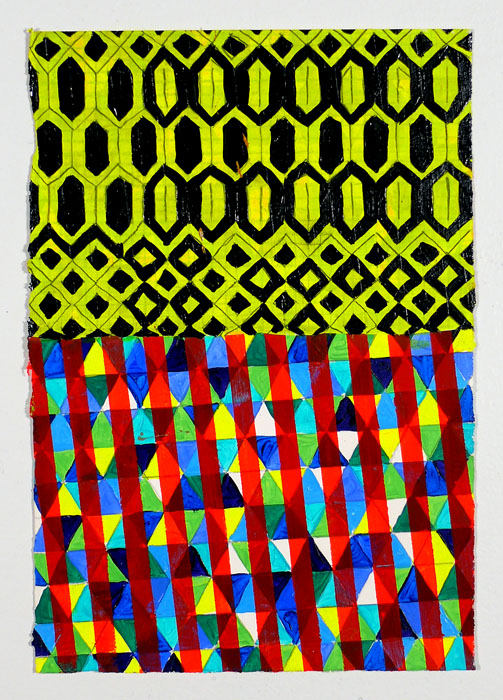
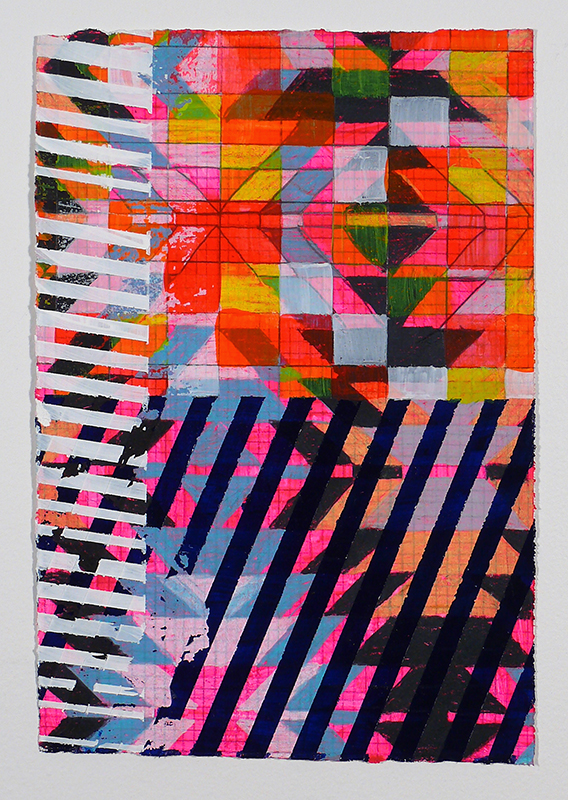
the original NY13#01, 11" X 7.5", mixed media on paper, 2013


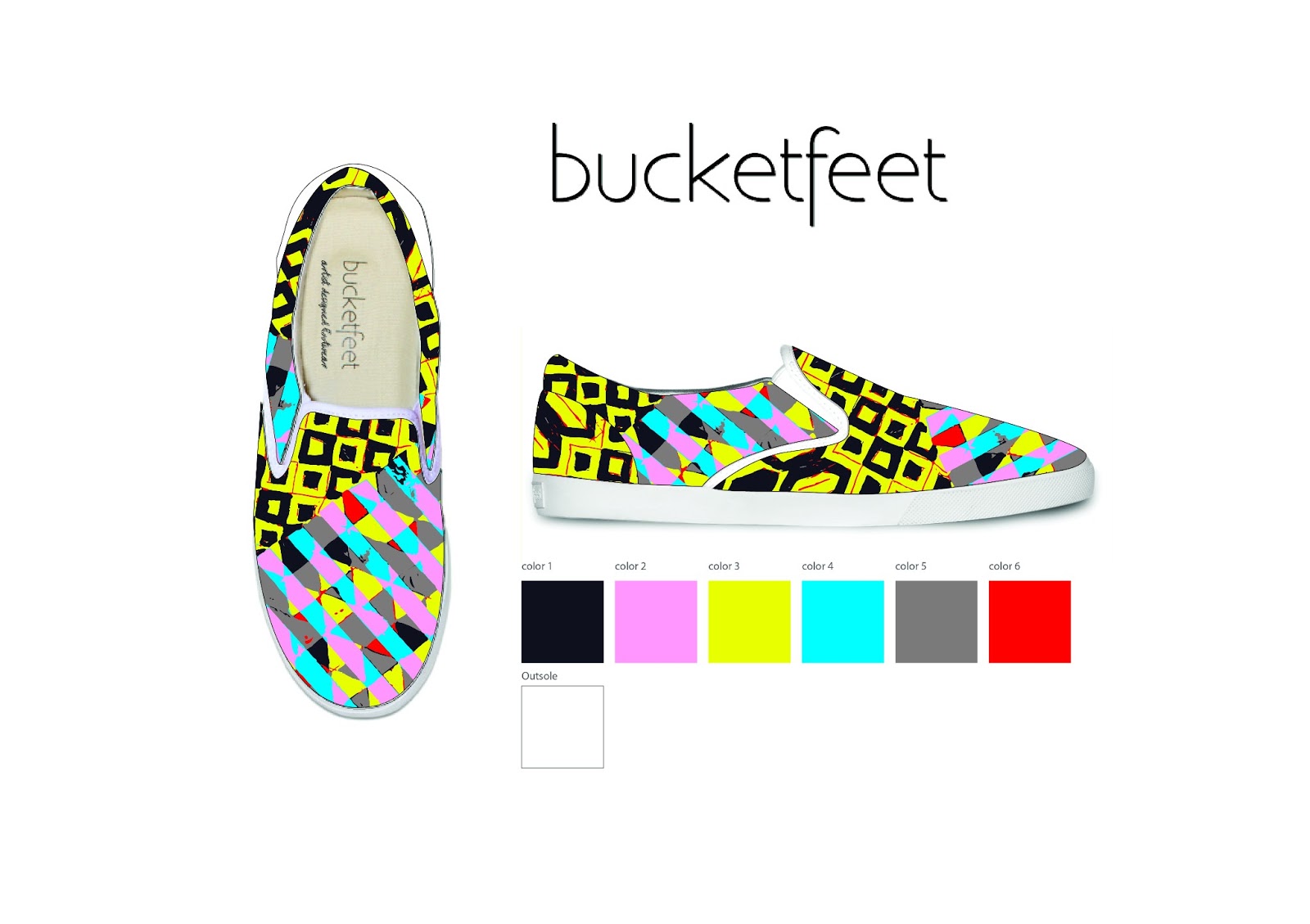
Bucketfeet is a Chicago based company that make limited run shoes using artists' designs. I wasn't quite sure what the submission process was like, but I knew it would be cool to have my paintings on some shoes. I want these shoes.

Turns out, the submission required some skills I had to learn. 
  1. Simplify the colors of a painting down to just 6 colors.
  2. Choose which 6 colors I wanted to use. It's much harder to mix color on a screen than on a palette using acrylic paint. Couldn't quite get the feisty orange I was after.
  3. Relearn how to fill a space with that 6 color painting.
You can see a bit of the process below. Click images for larger views.
My first design for a lace-up sneaker.


The 6 color version of NY13#01


Template for a lace-up sneaker using a 6 color version of  NY13#01


Mock up of slip-on sneaker using a 6 color version of NY13#01


My 2nd design for a slip-on sneaker.


the original NY12#15, 11" X 7.5", mixed media on paper, 2013


The 6 color version of NY12#15


Template for a slip-on sneaker using a 6 color version of  NY12#15


Mock up of slip-on sneaker using a 6 color version of NY12#15


Let's see if they make the cut!

Saturday, July 20, 2013

New Monoprints & How I Made Them

each, 11"x7.5", acrylic paint, printmaking ink on stonehenge white paper, 2013

You can view detailed images of all the prints at Etsy or my site.

So what's a monoprint anyway?
I know I get confused. For this series, it means that 1 printmaking block in 1 color is used to create 10 unique prints. The stamp's design is based on the pattern of Navajo saddle blankets.

How are they unique if they use the same printing block?
I use the block differently each time. Laying it down on the paper in different directions, many times. The color in each print is unique, I've brushed it on by hand. And there's lots of messiness and bleed throughs.

What makes them a series?
The 10 prints use a specific visual language. And because I say so.

Check out the transformation below.


Each print is 11" x 7.5" on stonehenge white paper. Here they are taped up and ready to roll! I decided to cut the space in half. The top half will be an imperfect Liberace bling. The bottom will be a bold graphic groovy.


Here's the first stage, painting the bottom half with a spectrum of color, vertical and horizontal.


Now I print them with the block. Above is a print, ink, inked piece of plexi, brayer and block. I spread the ink on the plexi with the brayer, then run the breyer over the block. This blog post breaks down the process a bit more.


Detail of the printing block. The block is an eraser like texture, E-Z Cut brand.


What the block looks like inked up.


I lay the block on a print and run another plexi brayer over it for good ink coverage, hopefully. It's never consistent.


Inking up the block again to continue printing on the bottom half.


Above and below are printed pieces with the top half painted either a complimentary or discordant color.


Above and below, the first layer of metallic acrylic paint.


And a second and third layer for others. The metallic tops won't be opague, they're a bit off and mottled. The color underneath comes through within its' square and along the taped edges.


The final pieces untaped and drying.


And of course at some point "I got inconfusion" and painted the wrong side of the tape on 1 print. There are only 10 prints in the series, but #11 is the happy accident that has a bigger silver top and it's kinda my favorite.


NY131411, 11"x7.5", acrylic paint, printmaking ink on stonehenge white, 2013


Monday, July 8, 2013

Photography & the American Civil War at The Met

More beauty and brutality at The Met.


Sojourner Truth, "I Sell the Shadow to Support the Substance", Unknown, 1864, Albumen silver print from glass negative, 3 3/8 × 2 1/8 in

from The Met's site;

Born Isabella Baumfree to a family of slaves in Ulster County, New York, Sojourner Truth sits for one of the war’s most iconic portraits in an anonymous photographer’s studio, likely in Detroit. The sixty-seven-year-old abolitionist, who never learned to read or write, pauses from her knitting and looks pensively at the camera. She was not only an antislavery activist and colleague of Frederick Douglass but also a memoirist and committed feminist, who shows herself engaged in the dignity of women’s work. More than most sitters, Sojourner Truth is both the actor in the picture’s drama and its author, and she used the card mount to promote and raise money for her many causes: I Sell the Shadow to Support the Substance. SOJOURNER TRUTH.
The imprint on the verso features the sitter’s statement in bright red ink as well as a Michigan 1864 copyright in her name. By owning control of her image, her “shadow,” Sojourner Truth could sell it. In so doing she became one of the era’s most progressive advocates for slaves and freedmen after Emancipation, for women’s suffrage, and for the medium of photography. At a human-rights convention, Sojourner Truth commented that she “used to be sold for other people’s benefit, but now she sold herself for her own.”


Slave Pen, Alexandria, Virginia, Andrew Joseph Russell,1863, Albumen silver print from glass negative, 10 1/16 x 14 3/8 in


This view of a slave pen in Alexandria guarded, ironically, by Union officers shows Russell at his most insightful; the pen had been converted by the Union Army into a prison for captured Confederate soldiers. Between 1830 and 1836, at the height of the American cotton market, the District of Columbia, which at that time included Alexandria, Virginia, was considered the seat of the slave trade. The most infamous and successful firm in the capital was Franklin & Armfield, whose slave pen is shown here under a later owner's name. Three to four hundred slaves were regularly kept on the premises in large, heavily locked cells for sale to Southern plantation owners. According to a note by Alexander Gardner, who published a similar view, "Before the war, a child three years old, would sell in Alexandria, for about fifty dollars, and an able-bodied man at from one thousand to eighteen hundred dollars. A woman would bring from five hundred to fifteen hundred dollars, according to her age and personal attractions." 


Ruins of Gallego Flour Mills, Richmond, Alexander Gardner, 1865, Albumen silver prints from glass negatives, 6 7/16 x 14 1/2 in


A Harvest of Death, Gettysburg, Pennsylvania, Photographer; Timothy H. O'Sullivan,  Printer; Alexander Gardner , :July 1863, Albumen silver print from glass negative, 7 × 8 7/8 in


Ordnance Wharf, City Point, Virginia, Thomas C. Roche, 1865, Albumen silver print from glass negative, 8 9/16 x 10 1/16 in


Contrabands Aboard U.S. Ship Vermont, Port Royal, South Carolina, Henry P. Moore, 1861, Albumen silver print from glass negative, 5 1/16 × 8 3/16 in


from The Met's site;
Moore focused his camera on the changed lives of African Americans in the aftermath of the Union victory (navy and army) at the Battle of Port Royal, South Carolina, in November 1861. With the departure of their plantation owners, coastal plantation workers were no longer slaves but, before the Emancipation Proclamation, not yet free. They were considered "contrabands," a term coined by Union General Benjamin Butler to describe their status as conscripted former slaves who had escaped the Confederacy. The U.S.S. Vermont served in the South Atlantic Blockading Squadron as a store and receiving ship, a hospital, and here as the backdrop for one of the war’s most revealing group portraits.


Brigadier General Gustavus A. DeRussy and Staff on Steps of Arlington House, Arlington, Virginia, Alexander Gardner, May 1864, Albumen silver print from glass negative,6 3/4 x 9 1/16in


from The Met's site;
Here, Union soldiers pose for the camera in deliberately casual attitudes on the front steps of the Confederate commander Robert E. Lee's mansion, which was confiscated by the government in 1861. Laying blame-literally at Lee's doorstep-for the vast suffering of the Civil War. The Union Army in 1864 began to bury its dead on Lee's property in what later became Arlington National Cemetery.


Confederate Method of Destroying Rail Roads at McCloud Mill, Virginia, Andrew Joseph Russell, 1863, Albumen silver print from glass negative, 6 3/8 × 7 11/16 in


Private John Parkhurst, Company E, Second New York Heavy Artillery, Reed Brockway Bontecou, 1865, Albumen silver print from glass negative, 7 7/16 × 5 3/16 in


from The Met's site;
Union Private Parkhurst received a gunshot wound to the head at Farmville, Virginia, in the final weeks of the Civil War. The ball fractured the upper portion of the soldier’s front bone, and he was removed to Harewood Hospital. Dr. Bontecou’s printed notes on the reverse of his card-mounted teaching photograph reveal that Parkhurst was fifty years old and that after treatment at the hospital his health progressed favorably. “Doing well,” Bontecou observed. The portrait is a good example of how at times the surgeon used enlargements to bring attention to a specific wound and its treatment. In this case, studying his patient from above, he also created a sublime document of medical recovery and human introspection.


Armory Square Hospital, Washington, Unknown, 1863–65, Albumen silver print from glass negative, 6 13/16 × 7 7/8 in


from The Met's site;
...in two years President Lincoln had 187 general hospitals built, providing 118,000 beds. The majority were in the District of Columbia, including Armory Square Hospital seen here. The view shows Ward F and appears to document an anniversary of the facility, complete with flags, evergreens, and hanging flower baskets. The hospital was constructed on land adjacent to the Smithsonian Institution, approximately where the National Air and Space Museum stands today.


Friday, June 28, 2013

A Boxer & Ken Price at The Met


Boxer at Rest, Greek, Hellenistic period, late 4th–2nd century B.C. Bronze inlaid with copper

beautiful and a bit grotesque.
from the Met's site,


The bronze statue Boxer at Rest was excavated in Rome in 1885 on the south slope of the Quirinal Hill near the ancient Baths of Constantine, where it is thought to have been displayed. The statue was intentionally buried in late antiquity, possibly to preserve it against the barbarian invasions that ravaged Rome in the fifth century A.D. The broad-shouldered, lanky pugilist is depicted just after a match sitting on a boulder to rest after the unnerving tension of the fight. Something catches his eye and makes him turn his head: perhaps the applause of the spectators or the entrance of his next opponent?
read more here.


Baby Blue (KP-2), 1994, ceramic and acrylic paint, 14 1/2 x 11 1/2 x 7 in


THE PINKEST AND HEAVIEST, 1986


Ken Price, Glass-Off, 2000


River of Lava, 2004, watercolor on paper, 11 x 8 3/4 in


Reltny, 1983


Saturday, June 22, 2013

Opening Thurs Night, "Folks I Like", NYC

Thurs June 27, 5:30-7 at Dixon Place, 161A Chrystie Street, NYC
I'm in a group show "Folks I Like", curated by Bobby Lucy. Includes;  Martyn ThompsonDove Drury-HornbuckleLarry KroneNatasha Gornikand Adam Sipe. Come by and say Hi!

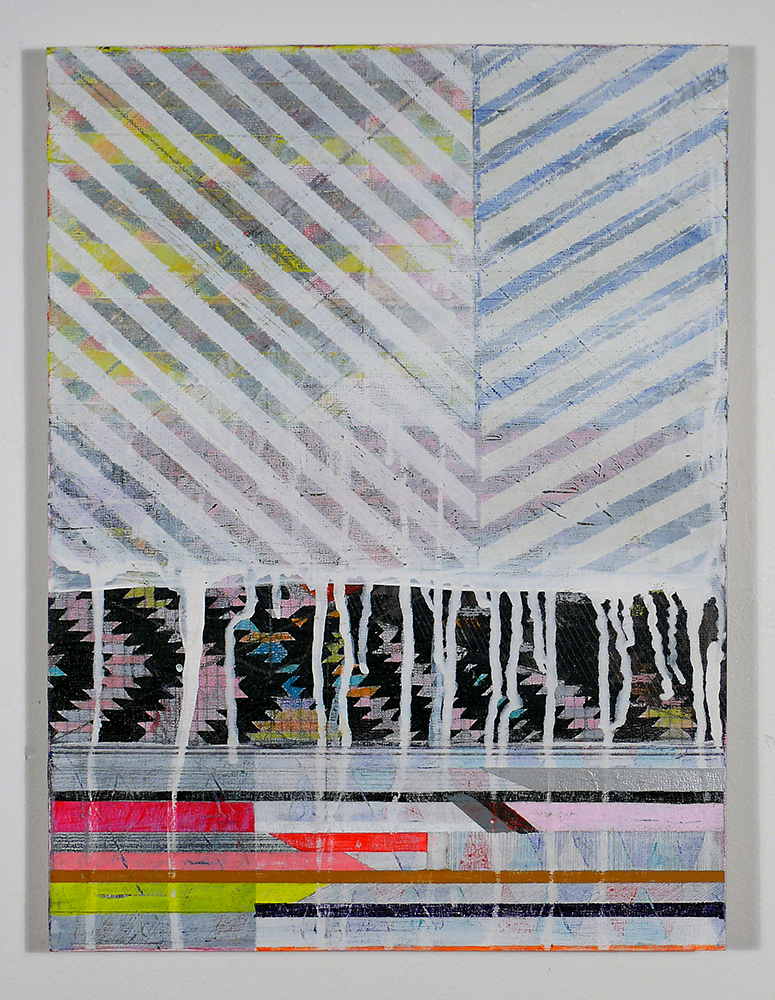
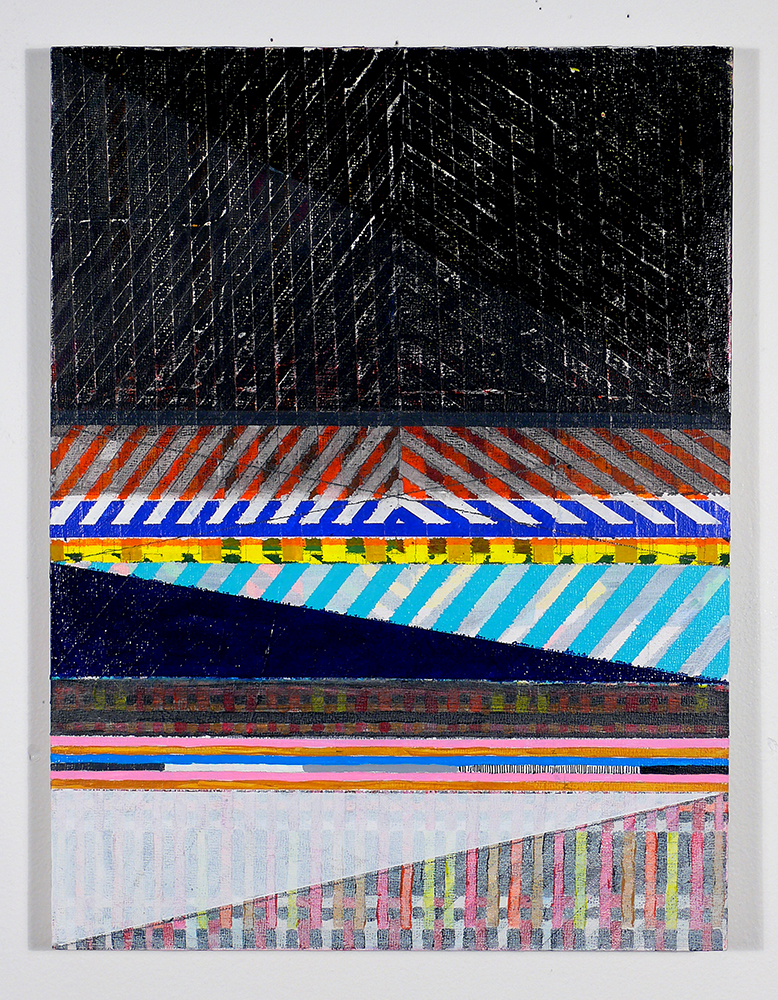
Below are some quick shots I took of the 4 framed pieces in the show, followed by 2 more panel pieces.
I think my paintings look best in a minimal frame. Here, I've used metal frames and mounted the paintings to watercolor paper with no matte.